Honors Collegium M122
Keywords in Theory: Anthropocene


Enrollment: Open to College Honors/College Scholars students
Course Description: (same as English M122) In an effort to call attention to planetary climate change, some geologists have named the ‘Anthropocene’ as a radical new geological epoch of environmental change akin to a meteor strike. They attribute the origins to the global rise of agriculture, nuclear radiation, and plastics. Yet scholars in the social sciences and humanities have pressed against this universal narrative to ask which humans are really making the impact? They point to histories of empire, militarism, and globalization as fundamental causes, and raise questions as to how to tell the Anthropocene story (or stories) with attention to both local context and planetary scale. This interdisciplinary course explores the Anthropocene debate from the perspective of writers, artists, and filmmakers, particularly from islands in the global south. It turns to key concepts in the emergent field of Anthropocene studies such as climate, weather, scale, and species. The course will be particularly concerned with Postcolonial and Indigenous perspectives, especially the relationship between land and (rising) sea. Requirements include active class participation, weekly discussion posts, a short presentation, a class trip to LA MOCA to see environmental art exhibitions by Julian Charrière (Switzerland) & Cecilia Vicuna (Chile), and a final research paper/project.
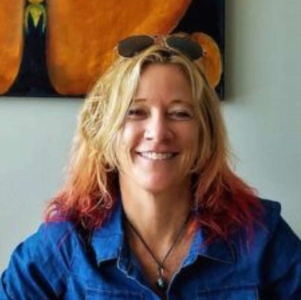
Elizabeth DeLoughrey is a professor in the English Department and the Institute of the Environment and Sustainability at UCLA who teaches postcolonial literature courses on the environment, globalization, and the Anthropocene and climate change, with a focus on the Caribbean and Pacific Islands. With Thom Van Dooren, she was co-editor of the interdisciplinary open-access journal Environmental Humanities until 2020. She is the author of “Routes and Roots: Navigating Caribbean and Pacific Island Literatures” (2007), and co-editor of the volumes “Caribbean Literature and the Environment: Between Nature and Culture” (2005); “Postcolonial Ecologies: Literatures of the Environment” (2011); and “Global Ecologies and the Environmental Humanities: Postcolonial Approaches” (2015). Her latest (open access) book, “Allegories of the Anthropocene,” examines climate change and empire in the literary and visual arts and was published by Duke University Press in 2019.